
Fusion's Funding Gap: Record Investment Still Isn't Enough to Build a Power Plant
Fusion developers raised more money in the year to July 2026 than ever before, and the capital their first power plants need is a different kind of money altogether.
A perspective from Open Doors Partners
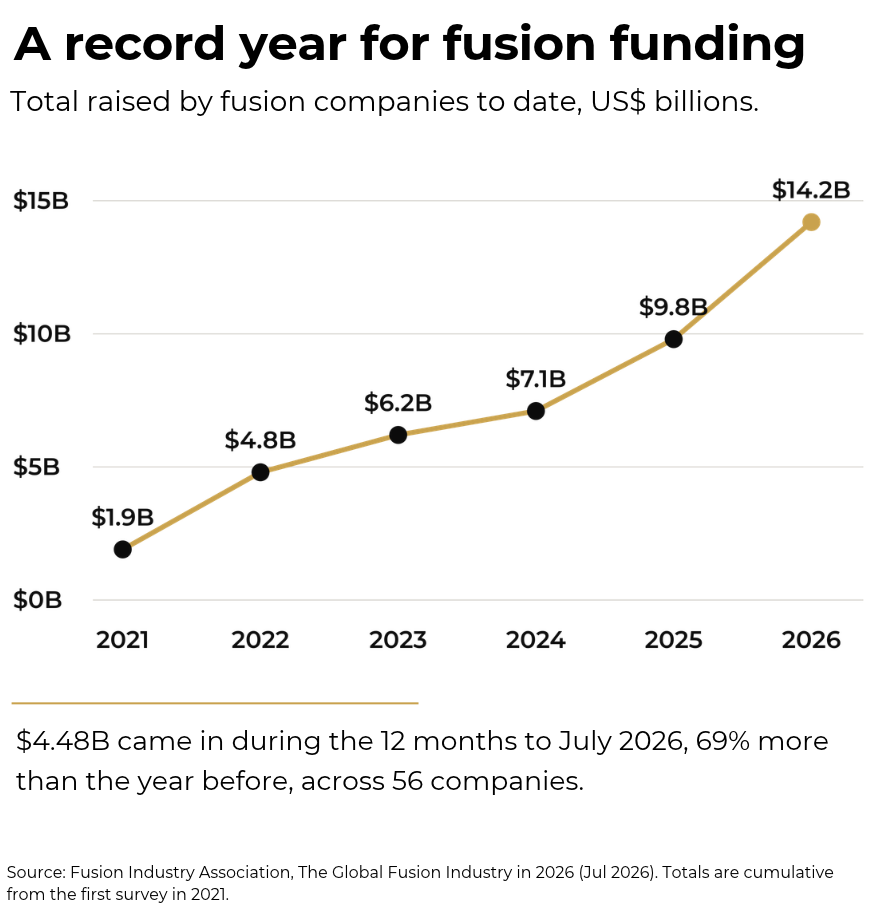
Fusion developers raised $4.48 billion in the 12 months to July 2026, a record and 69% more than the year before, according to the Fusion Industry Association (FIA). Yet two-thirds of the 56 companies it surveyed still name funding as their biggest short-term challenge.
Both facts hold because they describe different kinds of money. The capital raised so far answers a scientific question: can a machine reach the conditions for net energy? The capital the industry needs next answers a commercial one: can a plant be built, connected to the grid and paid for? Venture investors fund the first question. Buyers, lenders and infrastructure investors fund the second, and the handoff between them has barely begun.
A Record Year That Still Falls Short
The record caps a steep climb. Total funding has reached $14.24 billion, about seven times what the FIA counted in its first survey in 2021, and the last two years brought in more than the three before them.
The requirement sits on a different scale. In the FIA's 2025 survey, companies said they needed a combined $77 billion of additional investment to bring their first pilot plants online. That is a sum of company estimates for pilot plants, not the cost of commercializing fusion, and the FIA expects consolidation to shrink it. Even so, the record year that followed covered roughly 6% of it. The 2026 survey asked a narrower question, what one commercial plant would cost, and the average answer was $2.7 billion. Spread evenly, the record year comes to about $80 million per company.
The contrast sharpens against capital elsewhere. The four largest US hyperscalers guided to roughly $725 billion of capital spending for 2026, much of it on the AI infrastructure that has made power the limit on compute. At that pace, everything private fusion has raised since 2021 equals about one week of their spending. The capital exists. What fusion lacks is a form that capital at that scale is built to buy.
Where the Money Is Going
The record was not spread evenly either. Four rounds, raised by Commonwealth Fusion Systems, Proxima Fusion, Helion Energy and Inertia Enterprises, made up a little over half of the year's total. Five companies have now raised more than $1 billion each, all in the US, which is home to 28 of the 56 companies surveyed.
Fewer, larger checks are going to the developers closest to building something, and the FIA's own view is that few of today's companies will reach a commercial industry. That changes what a large round pays for: less experimentation, more engineering, siting and long-lead equipment, sized against the cost of a plant rather than a laboratory.
Governments Are Playing a Different Game
Public money could, in principle, close part of the gap. It is mostly not being used that way. Of the $14.24 billion the survey counts, only $0.98 billion, roughly 7%, is public. That share grew by less than $200 million over the past year while private funding grew by more than $4 billion, and the number of companies reporting a cost-sharing partnership with government fell from 20 to 16.
Governments are investing heavily in fusion, but mostly through national programs and state-backed projects rather than by funding private developers directly. The UK has committed more than £2.5 billion over five years, with £1.3 billion for STEP, its own prototype plant. Germany has pledged more than €2 billion over the current legislative period. China set up the state-owned China Fusion Energy Co. in July 2025 with 15 billion yuan (about $2.1 billion) of registered capital, roughly 11.5 billion yuan of it newly injected by state-owned investors.
For private developers, government support increasingly arrives as programs to compete for and partnerships to join, not as capital on their own balance sheets. That leaves commercial buyers and public markets to carry more of the load.
From Science Project to Infrastructure Project
This is where the 2026 survey adds its most important new data. For the first time, it asked about power purchase agreements and sites. Five companies now report a power purchase agreement, offtake agreement or similar commitment, two more are in talks, and six have a siting agreement.
The buyers stand out. Microsoft signed with Helion Energy in 2023. Google signed with Commonwealth Fusion Systems in June 2025 for power from its planned ARC plant in Virginia, and Eni signed for power from the same plant three months later. The customer base now runs from technology companies to an integrated energy company.
These contracts matter more for financing than for revenue. Lenders and infrastructure investors lend against contracted cash flows. A signed buyer turns a future plant from a technology program into a project with a counterparty, which is what debt, and the infrastructure equity that usually follows it, requires. Large power projects are typically financed in that order: contracts, then loans, then construction. No fusion plant has been financed this way yet, so today's agreements are early signs of bankability, not proof of it.
Public markets are the second route. General Fusion began trading on the Nasdaq on July 13, 2026, after merging with a special purpose acquisition company, and became the first listed fusion developer. TAE Technologies is completing a merger with an already-listed company, with a shareholder vote set for December 14, 2026. A listing brings repeat access to capital along with public scrutiny of every milestone, part of a wider change in how private companies approach going public.
The Next Challenge Is Building
Once financing depends on contracts and lenders, the risks that count change. The physics still has to work, but execution risk starts to matter as much: whether components can be made, sites permitted and connected, and fuel and materials supplied at plant scale. Companies in the survey rank neutron-resilient materials (57%), power efficiency (52%) and tritium self-sufficiency (52%) as their leading long-term concerns. Fusion companies spent $538 million with suppliers in 2025, according to the FIA's supply chain survey, a small sum next to the cost of a single plant.
Timelines tell the same story. Most companies, 71%, still expect the first plant to deliver commercial electricity in the 2030s, as they have since 2021. But the spread has widened: 13 companies now place first power after 2040, up from seven a year earlier. The new money is paying for a long engineering path rather than shortening it.
From Proving Fusion to Financing It
The next milestone for fusion is not another record round. It is the first plant financed on the strength of a credible construction plan, contracted buyers and a clear route to selling electricity. That is the real transition from scientific achievement to commercial infrastructure, and the start of fusion's industrial decade. For us, it comes down to one moment: the day a fusion developer's most important document is a loan agreement rather than a physics result.
Frequently Asked Questions
How much money has the fusion industry raised? Fusion companies have raised $14.24 billion in total, including $0.98 billion of public funding, according to the Fusion Industry Association's 2026 survey of 56 companies. A record $4.48 billion came in during the 12 months to July 2026, 69% more than the year before.
How much funding does fusion need to reach commercial power? In the FIA's 2025 survey, companies said they needed a combined $77 billion of additional investment to bring their first pilot plants online. The FIA expects consolidation to reduce that figure. In 2026, companies put the cost of a single commercial plant at an average of $2.7 billion.
Which fusion companies have power purchase agreements? Five companies report a power purchase agreement or similar commitment. Examples include Microsoft's agreement with Helion Energy, and Google's and Eni's agreements with Commonwealth Fusion Systems for its planned ARC plant in Virginia. No fusion plant has yet been financed on the strength of such a contract.
Is there a publicly traded fusion company? General Fusion became the first publicly listed fusion developer when it began trading on the Nasdaq on July 13, 2026, after a merger with a special purpose acquisition company. TAE Technologies is completing a merger with an already-listed company, with a shareholder vote set for December 14, 2026.
Sources
- • Fusion Industry Association, "The Global Fusion Industry in 2026", July 13, 2026.
- • Fusion Industry Association, "Fusion Industry Attracts Record Annual Funding of $4.48bn, Raising Total to $14.24bn", July 13, 2026.
- • World Nuclear News, "Fusion industry raised USD4.5 billion in past year, report says", July 14, 2026.
- • NEI Magazine, "Fusion industry attracts record annual funding of $4.48bn", July 20, 2026.
- • Nuclear Industry Association, "Fusion industry attracts record annual funding of $4.48bn", July 2026.
- • ExchangeMonitor, "Fusion funds increase but commercialization timelines remain unchanged, FIA reports", July 20, 2026.
- • Physics World, "Private investment in fusion firms jumps by $4.5bn", July 2026.
- • World Nuclear News, "Access to funding remains a major issue for fusion, says FIA", July 23, 2025.
- • Reuters via BOE Report, "Global investment in fusion energy rises the most since 2022", July 21, 2025.
- • Fusion Industry Association, "The Fusion Industry Supply Chain 2026", June 2026.
- • Fusion Industry Association, "U.S. Department of Energy Announces $8.5M for INFUSE Public-Private Partnership Program", November 2026.
- • GOV.UK, "UK Atomic Energy Authority Strategy 2026 to 2030", 2026.
- • ESG Today, "UK Unveils $3.3 Billion Fusion Strategy", March 2026.
- • American Nuclear Society, "U.K. vision for fusion", March 23, 2026.
- • Clean Energy Wire, "German government pledges more than €2 bln for nuclear fusion", October 2025.
- • Caixin Global, "China launches national fusion energy firm with $1.6 billion investment from SOEs", July 24, 2025.
- • Datacentres.com, "Hyperscaler Capex Guidance Passes $700B for 2026 as AI Demand Reshapes Data Centre Market", 2026.
- • Silicon Canals, "Four US tech giants spent roughly $410 billion on capital expenditure last year and are steering toward roughly $725 billion in 2026", 2026.
- • DatacenterDynamics, "Google-backed fusion firm Commonwealth Fusion Systems signs PPA with Italian energy company Eni", September 2025.
- • The Energy Year, "Eni signs $1-billion fusion power offtake agreement in the US", September 22, 2025.
- • Data Center Frontier, "Fusion Energy Moves Toward Reality: Strategic Investments by CFS, Google, and Eni Signal Commercial Readiness", 2025.
- • General Fusion, "General Fusion Becomes First Publicly Listed Fusion Company", July 13, 2026.
- • TAE Technologies, "Trump Media & Technology Group and TAE Technologies Announce Effectiveness of Form S-4 Registration Statement for Proposed Merger", November 2026.
—
Open Doors Partners LLC | Exempt Reporting Adviser
Informational only. Not investment advice and not an offer or solicitation to buy or sell any security. Private investments are speculative and illiquid and may result in loss of the entire investment. Forward looking statements may prove incorrect. Third party data has not been independently verified.
Read full disclosures here.