
The Fuel Gap: Why Enrichment Now Sets the Pace for Advanced Nuclear
The reactors designed for the next build cycle run on a fuel the United States barely produces, and the law cutting off its main foreign source takes full effect before the domestic capacity meant to replace it.
A perspective from Open Doors Partners
For most of the past decade, the hard questions about advanced nuclear were about the reactors: whether new designs could be licensed, built on budget, and financed. Those questions remain open, but a different one now sits upstream of them. Many of the designs moving toward deployment run on a fuel the United States produces in quantities measured in hundreds of kilograms, and the timeline for producing more is set by enrichment capacity that does not yet exist.
The fuel is high-assay low-enriched uranium, or HALEU. Natural uranium contains about 0.7% of the fissile isotope U-235. The light water reactors that make up today's fleet run on fuel enriched to between 3% and 5%. HALEU sits between 5% and 20%, which allows smaller cores and longer intervals between refueling. The World Nuclear Association counts more than half of the small modular reactor designs in development as needing it.
The Department of Energy estimates that domestic demand for HALEU could reach 50 metric tons a year by 2035. The only HALEU cascade operating in the United States, at Piketon, Ohio, produced about 0.9 tonnes a year under its demonstration contract. The distance between those two numbers is the subject of this piece: where it comes from, what is being built to close it, and what fills the gap in the meantime.
A Fuel With One Commercial Seller
Enrichment is concentrated in a way few industrial inputs are. Of roughly 68 million separative work units of world capacity in 2025, Russia accounted for about 43%, a British, Dutch, and German enrichment consortium for about 25%, China for an estimated 20%, and France for about 11%, according to World Nuclear Association data.
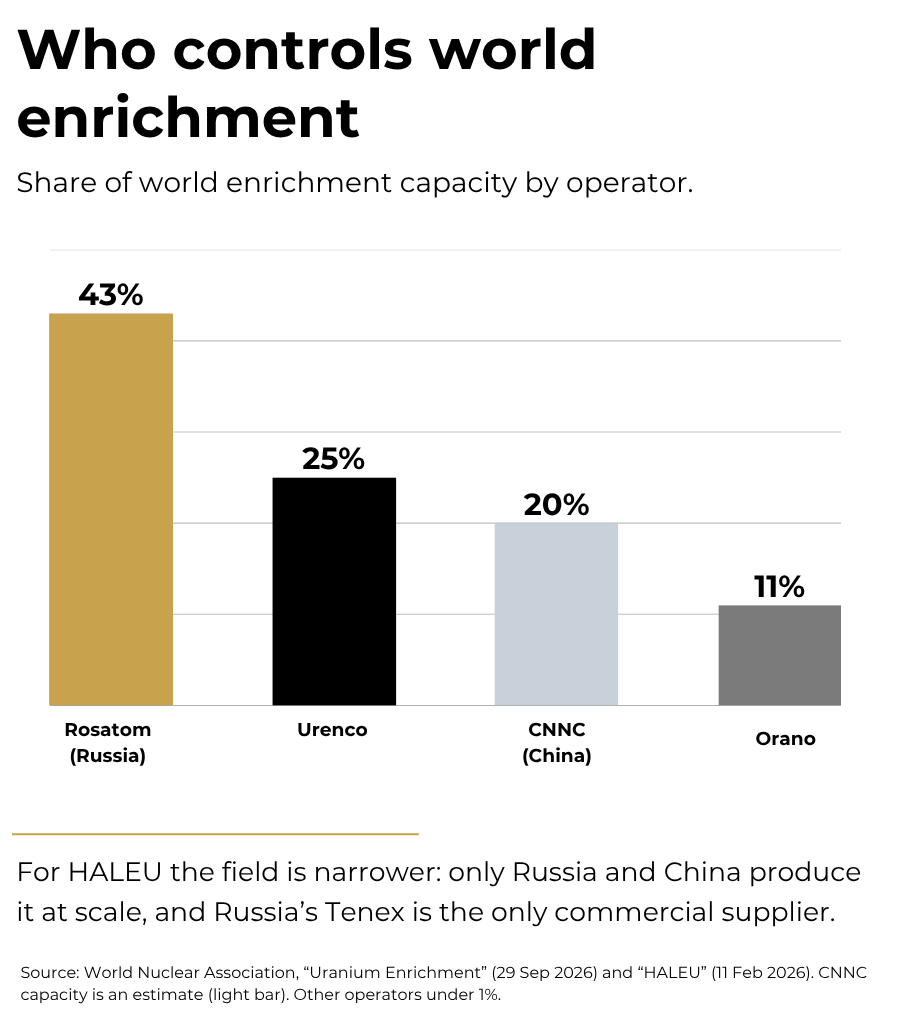
For HALEU the field is narrower still. Only Russia and China have the infrastructure to produce it at scale, and the association identifies a Russian state supplier as the only commercial source. The consequence of that concentration has already been visible once. In December 2022, a leading US demonstration reactor project announced a delay of at least two years, attributing it to the loss of the only commercial HALEU source after Russia's invasion of Ukraine and to the absence of domestic or allied capacity that could replace it in time.
The dependence also predates the new reactors. In 2025, US reactor operators bought about 13 million separative work units of enrichment services, and Russia was the largest single origin at 26%, ahead of US plants at 23%, according to the Energy Information Administration's annual marketing report. France supplied 18%, the United Kingdom 14%, and the Netherlands 8%. The existing fleet already draws on the same concentrated source that advanced reactors would have to replace, so the effort to build HALEU capacity runs alongside a parallel effort to replace Russian supply for conventional fuel.
The Cutoff Arrives Before the Capacity
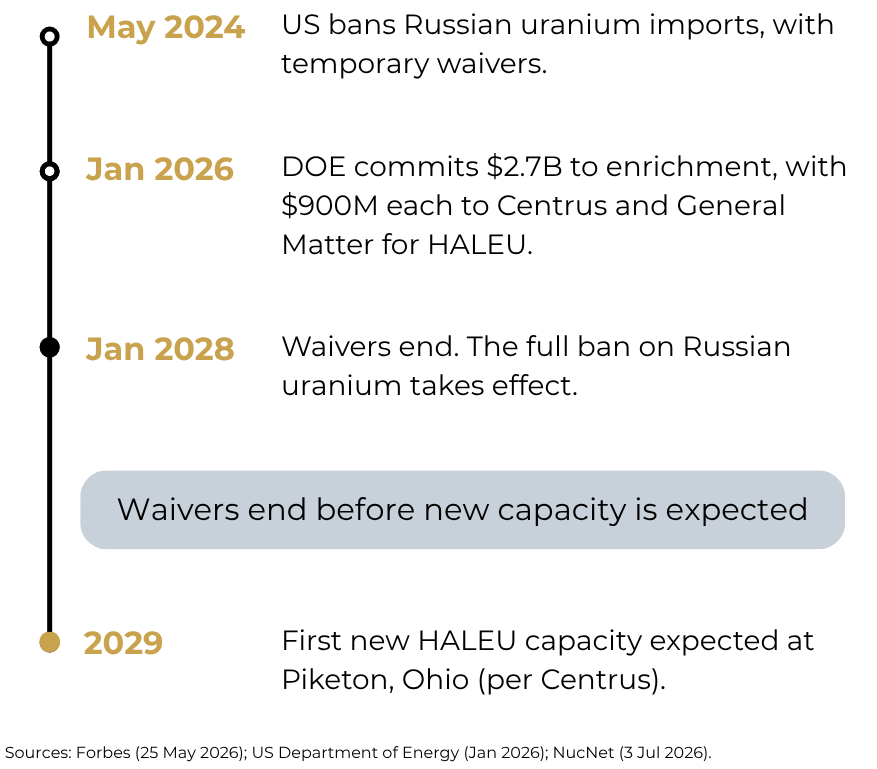
Policy has moved faster than the industrial base it depends on. The Prohibiting Russian Uranium Imports Act, enacted in May 2024, bans imports of Russian enriched uranium, with waivers that allow limited imports to continue until January 1, 2028. From that date the ban applies in full.
The replacement capacity runs on a later schedule. In January 2026 the Department of Energy committed $2.7 billion to domestic enrichment, including two awards of $900 million each for HALEU. The first new HALEU capacity at Piketon is expected by 2029, according to its operator, as part of an initial build-out sized at 12 tonnes a year. Even at full size, that build-out would equal about a quarter of the demand the department estimates for 2035.
Allied capacity follows a similar curve. The UK government has committed about £196 million toward a HALEU facility at Capenhurst in northwest England, with a target of producing up to 10 tonnes a year by 2031. That adds supply outside Russia and China, but on a timeline that begins after the US waivers end.
The sequence matters more than any single figure. The main foreign source closes before the first domestic expansion opens, and the expansion, once it arrives, is sized well below the demand estimate. Announced capacity and operating capacity are different quantities, and in a constraint like this one, the capacity that matters is built long before the story around it becomes visible.
Enrichment Is Only the First Gate
Enriched uranium is not yet fuel. Enrichment takes place while uranium is in the form of a gas, uranium hexafluoride. Before it can be fabricated into reactor fuel, it has to be deconverted into an oxide or a metal, a separate industrial step with its own facilities and licenses. The Department of Energy awarded contracts to six companies in October 2024 to bid on HALEU deconversion services, treating it as a distinct part of the supply chain that needs its own build-out. Fabrication into the specific fuel forms advanced designs use, from coated particles to metallic fuel, is a further step again.
Moving the material between those steps raises its own constraint. Above 5% U-235, the transport rules for uranium hexafluoride no longer allow packages to rely on the absence of water as a safety margin, and each package must be shown to remain subcritical even when fully flooded. In one fuel-cycle engineer's analysis, the binding limit on HALEU transport is therefore criticality rather than radiation, because the validated analyses needed to license larger payloads still depend on benchmark experiments that are only now being funded. The department has put $11 million toward five companies to develop and license new or modified HALEU transport packages, on timelines of up to three years.
Security requirements also step up with enrichment. Under the Nuclear Regulatory Commission's graded framework, material enriched to between 10% and 20% falls into Category II once a facility holds 10 kilograms or more of U-235, with stricter material control and physical protection than the Category III rules that govern most of today's fuel cycle. Every facility that handles HALEU at scale, from deconversion to fabrication to the reactor site, inherits those requirements.
Taken together, the chain has at least four stages, enrichment, deconversion, fabrication, and transport, and each is being built at roughly the same time. A delay at any one of them moves the date at which a reactor receives fuel, regardless of progress at the others.
What the Interim Stockpile Can Cover
Until commercial enrichment arrives, early HALEU comes from government stocks, and the department decides who receives it. The 2024 National Defense Authorization Act directed it to make at least 21 metric tons available to advanced reactor developers by June 2026.
The sources of that material are finite and specific. Idaho National Laboratory is recovering highly enriched uranium from the spent fuel of a retired experimental reactor and blending it down, and expects to produce just under 10 metric tons of HALEU once treatment finishes at the end of 2028, with half already allocated to a single developer. At the Savannah River Site, the department plans to blend down about 2.2 metric tons of highly enriched uranium into about 3.1 metric tons of HALEU. The Piketon demonstration cascade had produced more than 1.9 tonnes in total by mid-2026.
Set side by side, those identified sources come to roughly 15 metric tons, short of the 21-ton target Congress set, and under a third of a single year of the demand the department projects for 2035. This tally is our own, assembled from the published figures cited below, and it covers only the sources with public quantities attached. It does show the scale of the gap: the interim supply is a bridge to demonstration, not to deployment.
The allocation process reflects that scarcity. Fifteen companies applied in the first round, and five were selected in April 2025. Three more received conditional commitments in August 2025, and two in July 2026, one of them for a NASA mission. That makes ten commitments across three rounds. In most supply chains, scarcity is resolved by price. Here it is resolved by allocation, which makes the order in which advanced reactors reach demonstration partly a function of program selection rather than of what a developer can pay. A design with a licensing path and financing in place can still wait on fuel that cannot be bought commercially at any price.
A Second Customer With a Deadline
The civilian queue is no longer the only one. In August 2026 the Army selected five companies for its Janus program, which plans around 20 contractor-owned microreactors at five bases, backed by up to $2.2 billion, with a target of an operating reactor on a base by September 30, 2028. Every selected design plans to use HALEU. An Army official has said that fueling more than 20 reactors would likely exceed national supply, and the program has not yet settled how it will secure fuel for the ones already planned.
That places defense demand inside the same constrained pool as civilian demonstration reactors, with a deadline that falls in the same year the Russian waivers end. It also extends the dual-use logic that runs through defense technology into the fuel cycle: the same enrichment, deconversion, and fabrication capacity serves a base microreactor and a commercial plant, and both depend on it arriving on schedule.
The commercial side of that demand has its own momentum. AI infrastructure has become an energy problem, and compute demand has returned firm, always-on generation to the center of energy planning. Reactor demonstrations and long-term agreements for firm power all assume fuel arrives when the reactor is ready. The fuel cycle has become part of the same constraint, and for now it is the part with the least capacity behind it.
What Remains Unresolved
Several variables are not yet settled: whether new enrichment arrives on its stated schedule, whether deconversion, fabrication, and transport capacity are built in step with it, whether allied supply or further policy action bridges the period between the end of the waivers and the first new capacity, and whether civilian and defense demand develop at the pace their own planning assumes. Each would move the constraint in a different direction, and they do not all move together.
What has changed is where the question sits. We pay close attention to the fuel cycle, because the pace of advanced nuclear is becoming a question of enrichment as much as of reactor design.
Frequently Asked Questions
What is HALEU? High-assay low-enriched uranium is uranium enriched to between 5% and 20% of the fissile isotope U-235, compared with about 0.7% in natural uranium and 3% to 5% in fuel for today's light water reactors. The higher enrichment allows smaller reactor cores and longer intervals between refueling, and the World Nuclear Association counts more than half of the small modular reactor designs in development as needing it.
Why does the United States depend on Russia for enriched uranium? World enrichment capacity is concentrated among a small number of operators, and Russia held about 43% of it in 2025, according to the World Nuclear Association. In the same year, Russia was the largest single origin of enrichment services bought by US reactor operators, at 26%, ahead of US plants at 23%, according to the Energy Information Administration. For HALEU, a Russian state supplier is the only commercial source.
What happens to HALEU after enrichment? Enriched uranium leaves the enrichment plant as a gas, uranium hexafluoride, and has to be deconverted into an oxide or metal before it can be fabricated into reactor fuel. It then has to be moved in packages licensed to stay subcritical even when flooded, and facilities holding larger quantities fall under stricter Category II security rules. Each of these stages is still being built alongside enrichment.
How much HALEU is available before commercial enrichment arrives? The 2024 National Defense Authorization Act directed the Department of Energy to make at least 21 metric tons available by June 2026. Identified sources with published quantities, from Idaho National Laboratory, the Savannah River Site, and the Piketon demonstration cascade, come to roughly 15 metric tons by our tally, allocated through conditional commitments to ten recipients across three rounds.
Sources
- World Nuclear Association, "High-Assay Low-Enriched Uranium (HALEU)", updated 11 February 2026.
- World Nuclear Association, "Uranium Enrichment", 2026.
- World Nuclear News, "HALEU fuel availability delays Natrium reactor project", 15 December 2022.
- American Nuclear Society, "Uranium prices steady as EIA releases annual market report", 5 August 2026.
- US Department of Energy, "HALEU Frequently Asked Questions", last modified 30 December 2025.
- Orrick, "Prohibiting Russian Uranium Imports Act Unlocks $2.72 Billion for U.S. Uranium Market", 21 May 2024.
- NucNet, "Centrus Finalises $900 Million Haleu Enrichment Contract With US DOE", 3 July 2026.
- American Nuclear Society, "DOE awards $2.7B for HALEU and LEU enrichment", 6 January 2026.
- POWER, "Centrus Signs $900M DOE Contract, Pivots Sole U.S. HALEU Cascade to Commercial Operation", 2 July 2026.
- World Nuclear News, "UK aims for Urenco-built HALEU facility by 2031", 8 May 2024.
- Power Engineering, "DOE awards six contracts to build out U.S. advanced nuclear fuel supply chain", 9 October 2024.
- US Code of Federal Regulations, "10 CFR 71.55, General requirements for fissile material packages", current.
- Neutron Bytes, "The HALEU Transport Problem Isn't Radiation. It's Criticality", 31 July 2026.
- US Nuclear Regulatory Commission, "Security and Safeguards" (new fuels), updated 14 September 2026.
- American Nuclear Society, "Leading the charge: INL's role in advancing HALEU production", 24 October 2025.
- US Department of Energy, "DOE/EIS-0240 and DOE/EIS-0279: Amended Record of Decision (April 2025)", July 2025.
- Utility Dive, "DOE agrees to give HALEU to 5 advanced nuclear companies", 11 April 2025.
- US Department of Energy, "U.S. Department of Energy to Distribute First Amounts of HALEU to U.S. Advanced Reactor Developers", April 2025.
- US Department of Energy, "U.S. Department of Energy to Distribute Next Round of HALEU to U.S. Nuclear Industry", August 2025.
- US Department of Energy, "Energy Department to Distribute Third Round of HALEU to NASA and Radiant", 23 July 2026.
- Defense News, "US Army taps 5 firms to build on-base microreactors in nuclear energy push", 26 August 2026.
- Breaking Defense, "5 key questions the Army is still working out for its nuclear microreactor plan", August 2026.
—
Open Doors Partners LLC | Exempt Reporting Adviser
Informational only. Not investment advice and not an offer or solicitation to buy or sell any security. Private investments are speculative and illiquid and may result in loss of the entire investment. Forward looking statements may prove incorrect. Third party data has not been independently verified.
Read full disclosures here.