
The Cost-Exchange Problem: Defense Economics Are Being Rewritten
Air defense is moving from a contest of capability to a contest of volume, and attention is shifting to the systems that make each additional shot close to free.
A perspective from Open Doors Partners
For most of the missile age, air defense was judged by a single question: did the shot land? That question is giving way to two others. What did the shot cost, and how many more can be fired before the magazine runs dry?
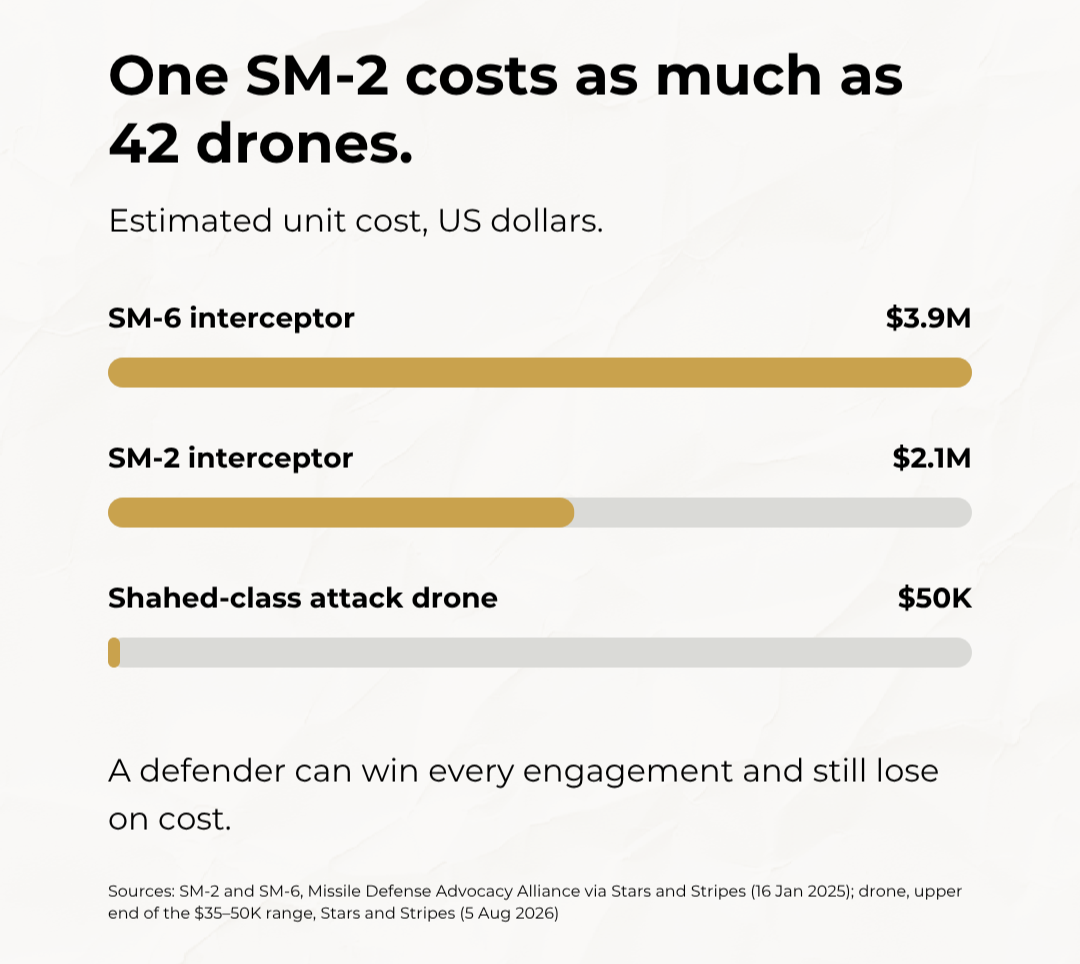
The Red Sea has made the change visible. Over roughly 15 months, US Navy ships defeated 380 one-way attack drones and ballistic and cruise missiles, and no Navy ship was hit. The Navy's surface force commander also published what it took: about 120 SM-2 missiles, 80 SM-6s, 20 Evolved Sea Sparrow and SM-3 missiles, and 160 rounds from five-inch guns. At published averages of about $2.1 million for an SM-2 and $3.9 million for an SM-6, those two types alone account for more than half a billion dollars. Many of the drones they met were reported to cost in the tens of thousands of dollars, and in some cases far less.
Winning every engagement, losing the arithmetic
The gap between those two figures is the cost-exchange ratio, and it describes a situation that earlier doctrine rarely had to price. A defender can intercept every threat and still spend faster than the attacker, because each engagement is a trade between something built to be cheap and something built to be certain.
The ratio is not the whole picture, and the strongest analysis says so. Work from the Center for Strategic and International Studies argues that comparing an interceptor's price to a drone's price leaves out what the interceptor protects: a warship worth around $2 billion and a shipping lane that carried about a tenth of global seaborne trade. Interceptors cost more than the threats they meet because they have to be faster, longer-ranged, and more reliable. The Navy's own leadership has said cost should not drive an individual decision to fire.
Both points hold. The cost-exchange problem is real because the price of a single shot is no longer the binding limit. The binding limit is volume.
Scale changes the math
A warship carries a fixed number of vertical launch cells, generally replenished in port rather than at sea. Interceptors are produced on multi-year lines sized for an era when threats were few and expensive. One-way attack drones invert both conditions. They are built quickly, in large numbers, from commercial components, and they can be launched in volumes that turn a defensive engagement into a question of inventory.
Under those conditions the defender's scarce input stops being capable and becomes throughput: shots per engagement, shots per deployment, and shots per year of industrial output. A defense that is excellent but finite can be exhausted by an offense that is mediocre but plentiful. This is the structural shift underneath the Red Sea numbers, and it is drawing capital and procurement attention toward effects that are cheap, plentiful, and in some cases reusable.
Four ways the shot is getting cheaper
Directed energy is the clearest break from the magazine model. The UK's DragonFire laser has shot down drones flying at up to 650 km/h in trials on the Hebrides range, at a cost the Ministry of Defence puts at about £10 per shot. The ministry has committed £316 million to fit it to Type 45 destroyers, with fitting planned by 2027, five years earlier than first scheduled. A laser does not run out of rounds in the conventional sense. It runs out of power and cooling.
High-power microwave systems extend the same logic to swarms. In a US live-fire demonstration in August 2025, one such system disabled a 49-drone swarm with a single pulse, in front of observers from the Defense Department and nine allied countries. Where a laser engages one target at a time, a microwave pulse covers an area.
Low-cost interceptors close the gap from the other side. Laser-guided rocket kits, estimated at roughly $15,000 to $20,000 each, have been used by US aircraft against Houthi drones, and in July 2026 the State Department approved a possible sale of up to 20,000 kits to Saudi Arabia. Interceptor drones push the price lower still: Ukrainian procurement listings show some models priced around $1,000 to $3,000.
Guns and electronic warfare are the oldest answers, and they are returning to the front of the queue. The Navy's surface force commander said modest threats are increasingly handled by guns, electronic countermeasures, and aircraft rather than missiles.

The magazine becomes a generator
Taken together, these approaches move the constraint. When the effect is a laser or a microwave pulse, the limiting resource is electrical power, thermal management, and the sensors that cue the shot. When the effect is a cheap interceptor, the limit is how quickly a manufacturer can scale. In both cases the question shifts from what a single weapon costs to what a system can sustain.
That shift sits close to patterns already visible elsewhere. Compute infrastructure has found that power, not chips, sets the ceiling, and defense is meeting a version of the same constraint at sea. It also strengthens the dual-use logic already shaping defense technology, since the components that make a shot cheap, from power electronics to commercial-grade drones, are the same ones civilian markets are already scaling.
What remains unresolved
The open question is pace. Procurement systems were built to buy small numbers of exquisite interceptors over long cycles, while the threat they now face iterates in months. Lasers still have to prove themselves in weather, haze, and sea spray, and microwave systems in crowded electromagnetic environments. Whether cheaper defenses can be fielded as fast as cheap drones are built is not yet settled, and the answer is likely to shape how the next generation of air defense is designed, bought, and powered.
Open Doors Partners follows this shift as part of its wider attention to defense and the foundations beneath it, because the economics of a single engagement are becoming the economics of an industrial base.
Frequently Asked Questions
What is the cost-exchange ratio in air defense? The cost-exchange ratio compares the cost of the weapon used to stop a threat with the cost of the threat itself. In the Red Sea, interceptors costing around $2 million to $4 million have been used against drones reported to cost in the tens of thousands of dollars or less. The ratio is a useful signal, but it leaves out the value of the ship or shipping lane being defended.
Why does the volume of drones matter more than their price? Warships carry a fixed number of launch cells, generally replenished in port, and interceptors are produced on multi-year lines. Drones built cheaply and in large numbers can be launched in volumes that turn each engagement into a question of inventory. The scarce input becomes how many shots a defender can sustain, not how good each shot is.
How do lasers and high-power microwaves change the economics? Directed-energy systems do not consume a missile per engagement. The UK Ministry of Defence puts the cost of a DragonFire laser shot at about £10, and a high-power microwave system disabled a 49-drone swarm with one pulse in an August 2025 US demonstration. Their limit shifts from munitions to electrical power, cooling, and sensing.
What remains unresolved about cheaper air defense? The main open question is pace. Procurement systems were designed to buy small numbers of expensive interceptors over long cycles, while drone threats iterate in months. Directed-energy systems also still have to prove their performance in weather, haze, sea spray, and crowded electromagnetic environments.
Sources
- Stars and Stripes, "Navy fired more than 200 missiles to fight off Red Sea shipping attacks, admiral says", January 16, 2025.
- Center for Strategic and International Studies, "Cost and Value in Air and Missile Defense Intercepts", February 13, 2024.
- UK Ministry of Defence, "Boost for Armed Forces as new laser weapon takes down high-speed drones", November 20, 2025.
- Epirus, "Leonidas High-Power Microwave Defeats 49-Drone Swarm, 100% of Drones Flown at Live-Fire Demonstration", September 10, 2025.
- Global Military, "US Clears $1.96 Billion Sale of 20,000 APKWS Laser-Guided Rockets to Saudi Arabia", July 17, 2026.
- Euromaidan Press, "Can Ukraine's $1,000 drones really beat Russia's $35,000 Shaheds?", July 16, 2025.
—
Open Doors Partners LLC | Exempt Reporting Adviser
Informational only. Not investment advice and not an offer or solicitation to buy or sell any security. Private investments are speculative and illiquid and may result in loss of the entire investment. Forward looking statements may prove incorrect. Third party data has not been independently verified.
Read full disclosures here.