
Orbit on a Schedule: Launch Becomes Routine
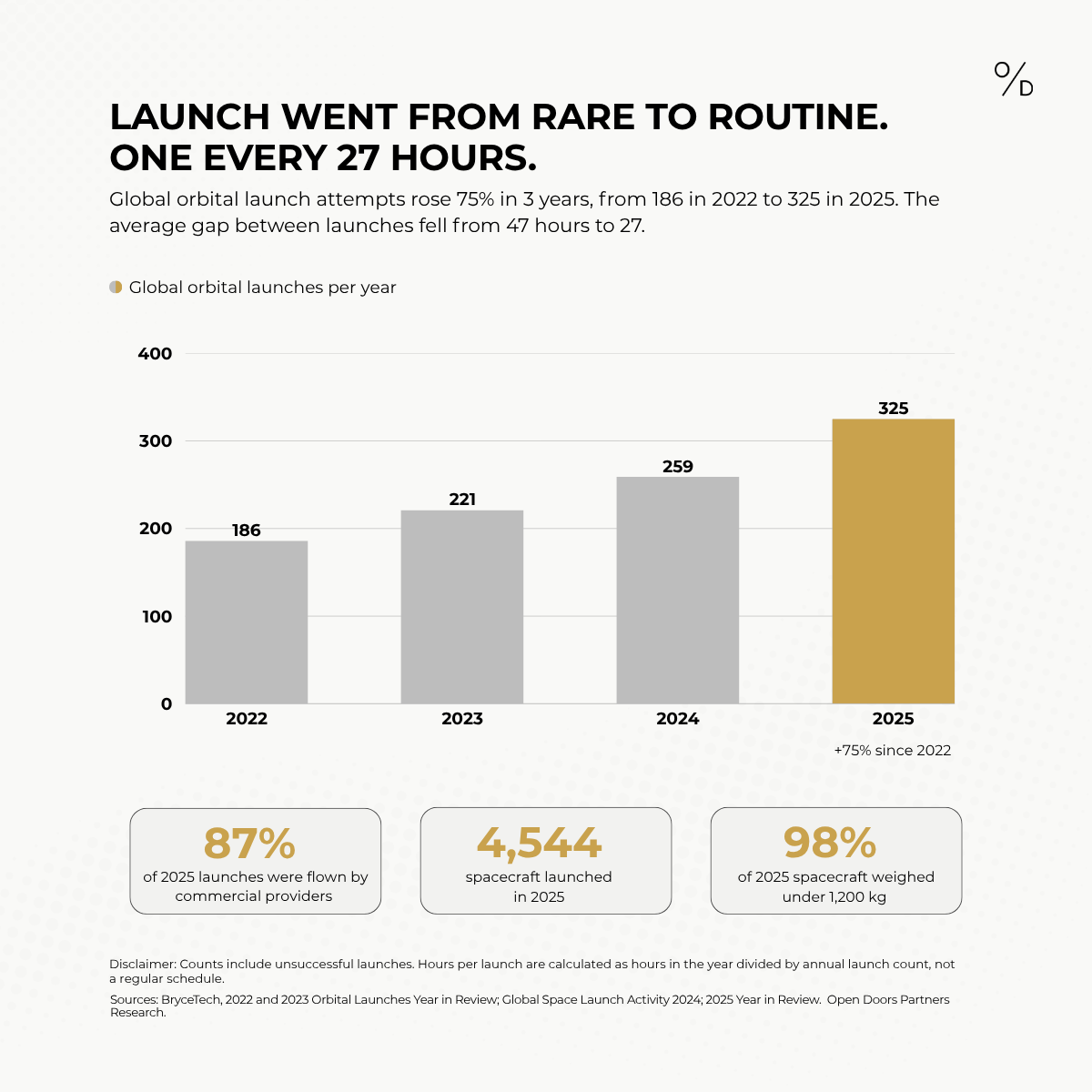
In 2025 the world averaged one orbital launch every 27 hours, and that frequency, more than price, is what begins to turn orbit into infrastructure.
A perspective from Open Doors Partners
For most of the space age, a launch was an event. It had a countdown, a press window and a crowd, and the spacecraft on top was built to justify the wait. Missions were designed around scarcity: one ride, years of preparation, and no second attempt for a long time.
That framing is becoming outdated. Orbit is acquiring a timetable.
The count that changed
BryceTech's review of 2025 counted 325 orbital launches worldwide, an average of one every 27 hours across the year, and approximately a 25% increase over 2024.
The payloads changed alongside the cadence. BryceTech counted 4,544 spacecraft launched in 2025, about 58% more than the year before, and 98% of them weighed under 1,200 kilograms. Spacecraft grew faster than launches, so each flight carried more of them: roughly 14 per launch in 2025, based on BryceTech's totals.
These are annual averages, not a published schedule, and the counts include launches that failed. The direction is still clear. Access to orbit is moving from occasional to continuous.
Cadence, not only cost
Most discussion of the commercial space economy centers on the falling price of a kilogram to orbit. Price matters, but it describes what a single trip costs. Cadence describes something different: how long an operator waits for the next one.
Infrastructure is defined less by its price than by the reliability of access to it. A freight network, a power grid and a data center are useful because their next unit of capacity is predictable. A business can plan around a rail timetable in a way it cannot plan around a charter that may or may not fly next year. Like most infrastructure, this capacity was built well before it became the story.
When launch occurs nearly once a day on average, the planning problem changes. Operators can begin to schedule around the next available flight rather than the next scarce one. A missed slot can cost weeks rather than years. A failed satellite can become a replacement order rather than the end of a program.
That is the structural shift the numbers point to. For many space services, the binding question is moving from whether a mission can afford orbit to how often it can return there.
What frequent access makes viable
The small-satellite share follows from this. When rides are frequent, spacecraft no longer need to be large, long-lived and engineered for a single opportunity. They can be smaller, cheaper and designed for replacement. Hardware begins to follow something closer to a release cycle: launch, learn, refresh.
Several categories of service depend on exactly that rhythm. Communications constellations need continuous replenishment to keep coverage steady as satellites age out. Earth observation is valued on revisit time, which depends on how many sensors are in orbit and how quickly new ones can be added. In-orbit services, from inspection to refueling, require predictable access to reach their customers at all.
None of these is new as an idea. What changes is the economic assumption underneath them. A business that needed a dependable launch every few weeks was hard to finance when launch was an event. As launch becomes a timetable, those models can be assessed on different terms across aerospace, closer to how terrestrial networks are planned than how missions were once funded.
There is a second-order effect on the ground. When orbit is reachable on a schedule, the constraint migrates elsewhere: to satellite manufacturing throughput, ground-station capacity, spectrum, and the tracking of an increasingly crowded environment. The bottleneck does not disappear. It moves downstream of the rocket.
A narrow supply base
The open question sits on the supply side. Much of the growth in launch activity is concentrated among a small number of providers. BryceTech's figures show U.S. providers conducting nearly 60% of 2025 launches, with a single operator accounting for roughly half of the global total.
Infrastructure that depends on very few suppliers carries a different risk profile from infrastructure with many. A grounding, a policy change or a shift in one provider's priorities could alter cadence for everyone downstream. Demand is broadening across commercial, civil and sovereign customers. Whether launch supply broadens with it, or stays this concentrated, is not yet settled.
The answer determines whether orbit behaves like a utility or like a timetable kept by very few hands.
Frequently Asked Questions
How many orbital launches were there in 2025? BryceTech counted 325 orbital launches worldwide in 2025, an annual-average rate of roughly one every 27 hours, and approximately a 25% increase over 2024. The totals include launches that failed, and the 27-hour figure is an average rather than a schedule.
What is launch cadence? Launch cadence is how frequently orbital launches occur. It is distinct from launch cost, which describes the price of a single trip. Cadence describes how long an operator waits for the next available flight. When cadence is high and predictable, operators can plan around regular access to orbit, which allows space services to be designed and financed more like terrestrial infrastructure.
Why are most satellites launched today so small? In 2025, 98% of the 4,544 spacecraft launched weighed under 1,200 kilograms, according to BryceTech. Frequent launch reduces the need for large, long-lived spacecraft built around a single opportunity. Smaller satellites can be designed for replacement and refresh, and more of them fit on each flight, which raised the average number of spacecraft per launch.
Is global launch supply concentrated? Launch activity is concentrated among a small number of providers. BryceTech's figures show U.S. providers conducting nearly 60% of 2025 launches, with a single operator responsible for roughly half of the global total. Whether supply broadens as demand from commercial, civil and sovereign customers grows is not yet settled.
Sources
- BryceTech, "Orbital Launches 2025" (2025 Year in Review), 2026.
- Via Satellite, Mark Holmes, "BryceTech Report Shows SpaceX Accounted for 50% of Launches in 2025", April 10, 2026.
- Wikipedia, "2024 in spaceflight", accessed October 14, 2026.
- Wikipedia, "2023 in spaceflight", accessed October 14, 2026.
- Wikipedia, "2022 in spaceflight", accessed October 14, 2026.
—
Open Doors Partners LLC | Exempt Reporting Adviser
Informational only. Not investment advice and not an offer or solicitation to buy or sell any security. Private investments are speculative and illiquid and may result in loss of the entire investment. Forward looking statements may prove incorrect. Third party data has not been independently verified.
Read full disclosures here.